

Creativity is in crisis.
In 1968, researcher George Land administered a creativity test originally developed for NASA scientists to 1,600 children, ages 3 to 5. The results were striking: 98% scored at the genius level for divergent thinking, the ability to imagine multiple solutions to a problem.¹
He tested the same children again at age 10. Genius-level scores dropped to 30%. At age 15, just 12%. By adulthood, only 2%.
Land later concluded that the problem wasn’t talent. It was the process of education itself. We condition creativity out of people, one standardized test, one “wrong answer,” one “be practical” at a time.
¹ Land, G., & Jarman, B. (1993). Breakpoint and Beyond: Mastering the Future Today. HarperBusiness.

The future demands different skills.
We are raising a generation caught in an impossible bind. On one side, employers need people who can innovate, adapt, collaborate, and solve problems that don’t have textbook answers. On the other hand, more young people are reporting persistent sadness and hopelessness than at any point in recorded history.²
These two crises share a common root: as schools narrow their focus to testable outcomes, an entire generation has lost access to the experiences that build creative capacity: making things, exploring ideas, taking risks, and discovering who they are through self-expression. Society simultaneously created a crisis in our children and eliminated the very activities proven to prevent it.
What Gets Lost
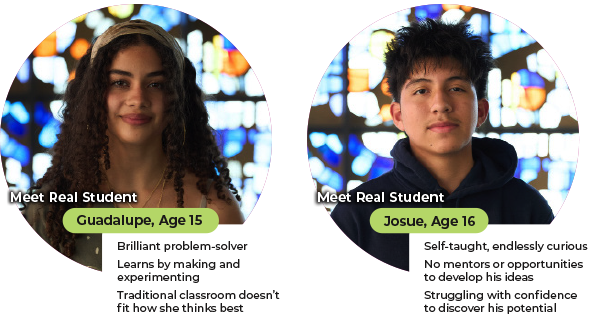
Kids who think differently get labeled as struggling. Kids who learn by doing get left behind. Individual strengths go undiscovered, confidence quietly disappears, and skills like adaptability, collaboration, and creative problem-solving never get the chance to develop. And the adults in the room? They’re often too far removed from their own creative selves to recognize what’s missing or model what’s possible.
The creativity deficit isn’t a side effect of modern life. It’s the cost of a system that was never designed to nurture it.
² Haidt, J. (2024). The Anxious Generation. Penguin Press. ³ Nagata, J.M. et al. (2024). BMC Public Health. ⁴ College Board and U.S. Chamber of Commerce. New Hire Readiness Report. 2025; PricewaterhouseCoopers. 20th CEO Survey. 2017.
The Good News
This is not a story without hope. Creativity is not a fixed trait. It is not a talent you either have or don’t. It is a capacity, a muscle, a practice. And like any muscle, it can be rebuilt.
Study after study shows that creative expression reduces anxiety, builds resilience, develops identity, and improves outcomes across mental health, academic performance, and workforce readiness. The interventions exist. They work. What’s missing is the infrastructure to deliver them at scale, for kids, for the adults who raise and teach them, and for communities that have never had reliable access to creative spaces and experiences.
That’s exactly what we’re building.


— Sir Ken Robinson
The Center is here to restore what we've lost.
The Center is not an arts organization. We are a creative infrastructure. One that treats creative exploration as essential to mental health, workforce development, and human potential. Through intentional experiences that give young people and the adults who support them time to discover, grow, and share what they’re capable of, The Center restores what schools and communities have been forced to cut.
Because the answer to a screen-saturated, anxiety-ridden society is not treating the symptoms we created. It’s giving back what we took and building the systems that make sure it’s never lost again.